

Company Cars Guide
The Ultimate Company Cars Guide

Thinking about getting a new company car?
We recognise that there are now many factors to consider when making your choice, which can make things difficult and time consuming.
We’ve created this guide to help you make the right decision.

The Basics
If an individual’s employer provides them with a car that is available for private use, tax & employer’s National Insurance will arise on the “cash equivalent”. The cash equivalent is calculated taking a percentage set by HMRC & applying it to the vehicle’s adjusted list price.
The adjusted list price is the manufacturer’s list price for the car, plus delivery costs & the costs of any accessories fitted to the vehicle (with some exemptions, for example if the vehicle needs to be modified for use by someone who is disabled.)
The percentages set by HMRC can be found at section 2.
Adjustments can be made where the employee makes either a capital contribution towards the cost of the car or is required to make payments for private use of the car.
There are now many different engine types that can make a big impact on this taxable benefit in kind figure. We took an example budget of roughly £35,000, and had a look at the different options of Volkswagen Hatchbacks available (all registered after April 2020), to see what the most tax efficient choice was for a higher rate taxpayer in the 2025/26 tax year:
| Fully Electric | Hybrid | Petrol | Diesel | |
|---|---|---|---|---|
| List Price | £37,060 | £36,605 | £34,055 | £35,315 |
| CO2 Emissions | 0g/Km | 21g/Km | 131g/Km | 120g/Km |
| Electric Range | 265 Miles | 42 Miles | N/A | N/A |
| Monthly Tax Due 2023/2024 | £37.06 | £109.82 | £363.25 | £353.15 |
From a pure tax point of view, the fully electric model is the winner, saving around 90% of tax compared to the petrol and diesel options. This tends to be the result in most scenarios, because no petrol or diesel engine can compete with the low CO2 emissions that hybrid and electric engines produce.
The tax that is due from vehicle benefits in kind can be reported on an annual basis via form P11D and income tax collected through the employee’s self-assessment tax return or an update to their PAYE tax code. Alternatively, benefits can be payrolled so that the tax due from employees is collected from their salary each month.
From April 2026 all vehicle benefits must be payrolled and there will no longer be an option for the annual P11D process.
The Basics
If an individual’s employer provides them with a car that is available for private use, tax & employer’s National Insurance will arise on the “cash equivalent”. The cash equivalent is calculated taking a percentage set by HMRC & applying it to the vehicle’s adjusted list price.
The adjusted list price is the manufacturer’s list price for the car, plus delivery costs & the costs of any accessories fitted to the vehicle (with some exemptions, for example if the vehicle needs to be modified for use by someone who is disabled.)
The percentages set by HMRC can be found at section 2.
Adjustments can be made where the employee makes either a capital contribution towards the cost of the car or is required to make payments for private use of the car.
There are now many different engine types that can make a big impact on this taxable benefit in kind figure. We took an example budget of roughly £35,000, and had a look at the different options of Volkswagen Hatchbacks available (all registered after April 2020), to see what the most tax efficient choice was for a higher rate taxpayer in the 2025/26 tax year:
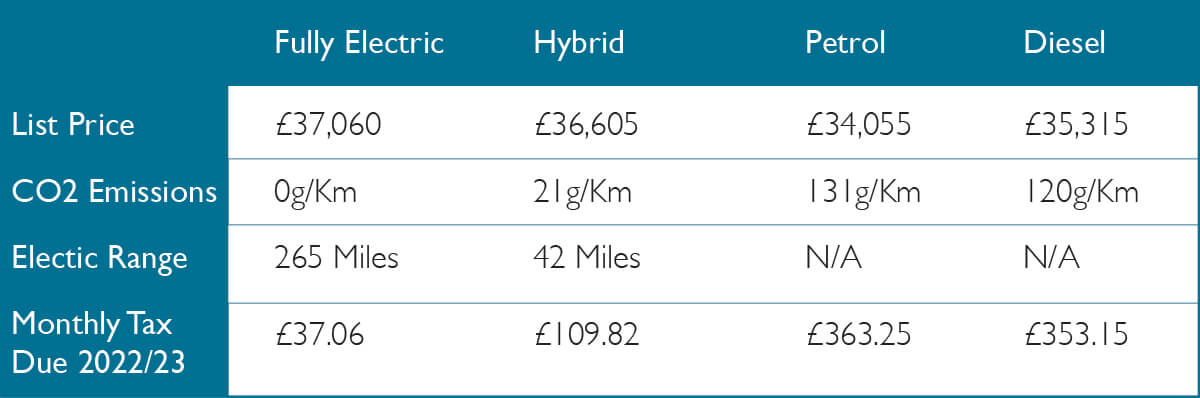
From a pure tax point of view, the fully electric model is the winner, saving around 90% of tax compared to the petrol and diesel options. This tends to be the result in most scenarios, because no petrol or diesel engine can compete with the low CO2 emissions that hybrid and electric engines produce.
The tax that is due from vehicle benefits in kind can be reported on an annual basis via form P11D and income tax collected through the employee’s self-assessment tax return or an update to their PAYE tax code. Alternatively, benefits can be payrolled so that the tax due from employees is collected from their salary each month.
From April 2026 all vehicle benefits must be payrolled and there will no longer be an option for the annual P11D process.

What Rate will my Company Car be?
The percentages below will apply until the end of the 2025/26 tax year:
| CO2 (g/km) | Electric Only Range (Miles) | 2022/23 |
| 0 | n/a | 3% |
| 1-50 | >130 | 3% |
| 1-50 | 70-129 | 6% |
| 1-50 | 40-69 | 9% |
| 1-50 | 30-39 | 13% |
| 1-50 | <30 | 15% |
| 51-54 | 16% | |
| 55-59 | 17% | |
| 60-64 | 18% | |
| 65-69 | 19% | |
| 70-74 | 20% | |
| 75-79 | 21% | |
| 80-84 | 22% | |
| 85-89 | 23% | |
| 90-94 | 24% | |
| 95-99 | 25% | |
| 100-104 | 26% | |
| 105-109 | 27% | |
| 110-1114 | 28% | |
| 115-119 | 29% | |
| 120-124 | 30% | |
| 125-129 | 31% | |
| 130-134 | 32% | |
| 135-139 | 33% | |
| 140-144 | 34% | |
| 145-149 | 35% | |
| 150-154 | 36% | |
| 155-159 | 37% | |
| 160+ | 37% |
For diesel cars, the percentages above are increased by 4%, with the maximum being 37%. This increase is not required if the car is certified as meeting the Euro standard 6d.
What Rate will my Company Car be?
The percentages below will apply until the end of the 2025/26 tax year:
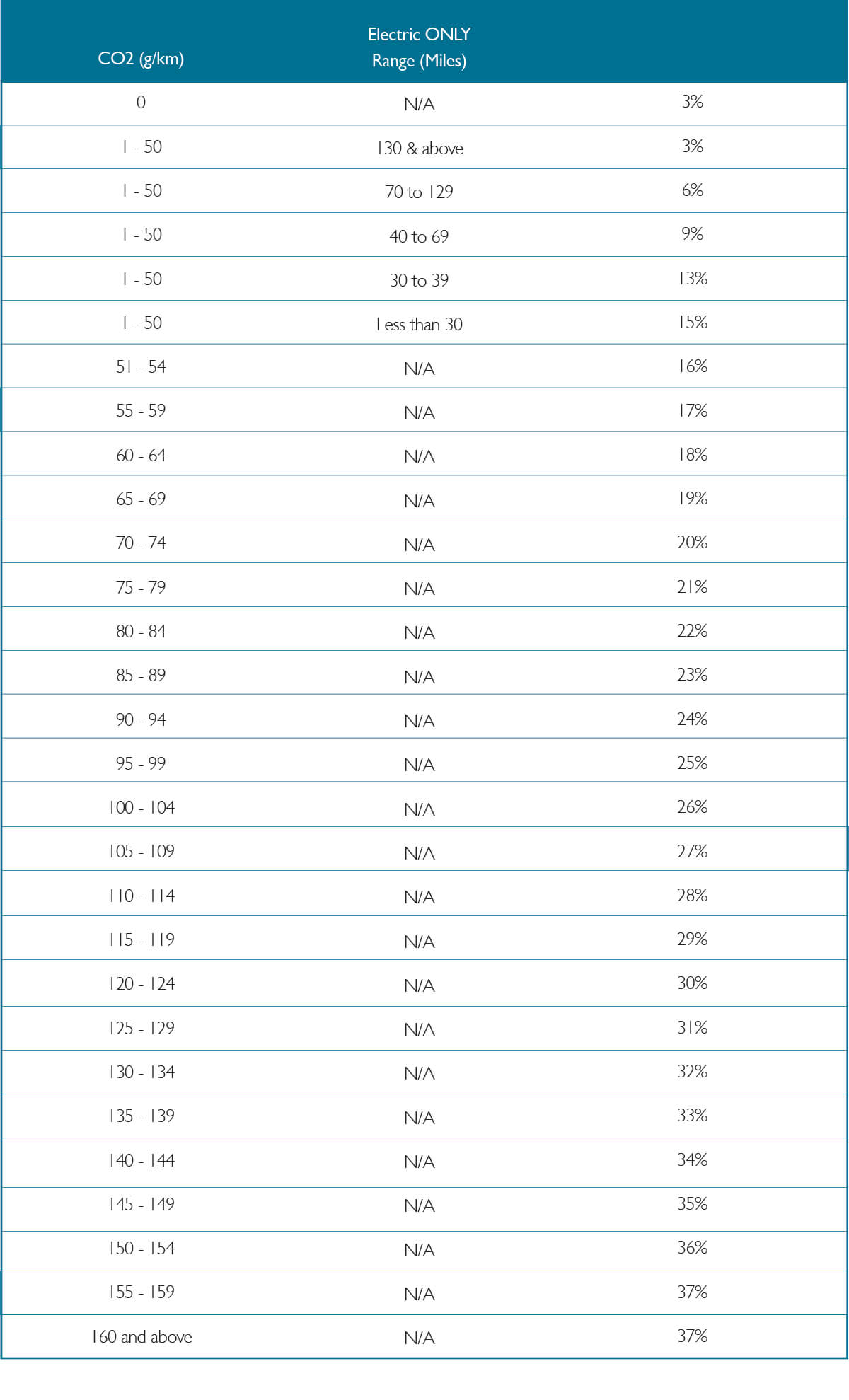
For diesel cars, the percentages above are increased by 4%, with the maximum being 37%. This increase is not required if the car is certified as meeting the Euro standard 6d.

Personal Tax on a Company Van
If a vehicle classes as a van, the cash equivalent is based on a flat rate figure that HM Revenue and Customs provide. For the year ended 5 April 2026, this figure is £4,020.
For more on whether a vehicle classes as a car or a van for personal tax purposes, see the “Is it a Car or a Van?” section.
Grants for zero emissions vans
If the van has zero-emissions, the benefit in kind is nil. There are Government grants available for some zero emission vans. More information can be found here: https://www.gov.uk/plug-in-vehicle-grants/vans

Fuel & Mileage
Employer Provided Fuel
If your employer provides fuel (petrol or diesel) for your company vehicle, this will give rise to a separate taxable benefit in kind.
To calculate the taxable amount, the percentage determined by the tables in section two is applied to a figure set by HMRC. For 2025/26, this figure is £28,200. For example, using our Volkswagen Golf from Section 1, the petrol car would have a fuel benefit of £9,024 whereas the hybrid car would have a fuel benefit of £2,538.
Therefore, if you are a higher rate taxpayer (paying tax at 40%), a petrol fuel benefit of £9,042 would cost you £3,610 in tax. It is therefore worth considering whether you would actually spend this much on fuel, because if not, the benefit simply isn’t worth it.
If fuel is provided for a company van in 2025/26, a standard figure of £769 is used.
Mileage Rates
If you use a vehicle for a genuine business journey (using either a company car or a private car), your employer can reimburse you by using HMRC’s flat rates. No tax or National Insurance arises on these rates.
HMRC’s rules about what constitutes a business journey are complex so you may need to seek more advice from us. A journey must be undertaken either in the performance of an employee’s duties or to travel to a place that it is necessary for an employee to attend to perform their duties. Travel from home to a permanent workplace is not a business journey.
There are different rates depending on whether you use a company vehicle or a private vehicle.
For a private vehicle, the current rates are:
| Type of Vehicle | First 10,000 miles | Above 10,000 miles |
| Cars and Vans | 45p | 25p |
| Motorcycles | 24p | 24p |
| Bikes | 20p | 20p |
It is worth noting, if your employer reimburses you below these amounts, you can make a claim for additional tax relief on the difference. If your employer reimburses you above these amounts, the difference will be subject to tax & National Insurance.
For a company vehicle, HM Revenue and Customs update the advisory rates every quarter, and can be found using the following link: https://www.gov.uk/guidance/advisory-fuel-rates
Fuel & Mileage
Employer Provided Fuel
If your employer provides fuel (petrol or diesel) for your company vehicle, this will give rise to a separate taxable benefit in kind.
To calculate the taxable amount, the percentage determined by the tables in section two is applied to a figure set by HMRC. For 2025/26, this figure is £28,200. For example, using our Volkswagen Golf from Section 1, the petrol car would have a fuel benefit of £9,024 whereas the hybrid car would have a fuel benefit of £2,538.
Therefore, if you are a higher rate taxpayer (paying tax at 40%), a petrol fuel benefit of £9,042 would cost you £3,610 in tax. It is therefore worth considering whether you would actually spend this much on fuel, because if not, the benefit simply isn’t worth it.
If fuel is provided for a company van in 2025/26, a standard figure of £769 is used.
Mileage Rates
If you use a vehicle for a genuine business journey (using either a company car or a private car), your employer can reimburse you by using HMRC’s flat rates. No tax or National Insurance arises on these rates.
HMRC’s rules about what constitutes a business journey are complex so you may need to seek more advice from us. A journey must be undertaken either in the performance of an employee’s duties or to travel to a place that it is necessary for an employee to attend to perform their duties. Travel from home to a permanent workplace is not a business journey.
There are different rates depending on whether you use a company vehicle or a private vehicle.
For a private vehicle, the current rates are:
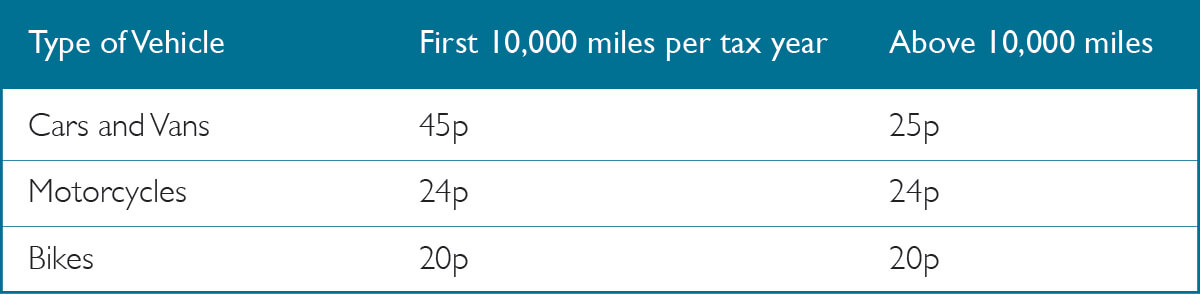
It is worth noting, if your employer reimburses you below these amounts, you can make a claim for additional tax relief on the difference. If your employer reimburses you above these amounts, the difference will be subject to tax & National Insurance.
For a company vehicle, HM Revenue and Customs update the advisory rates every quarter, and can be found using the following link: https://www.gov.uk/guidance/advisory-fuel-rates

Provision of Electricity by an Employer
Electricity is not treated as a fuel so there is no fuel benefit charge in relation to electric vehicles, but it is still considered as a type of benefit and there may still be tax to pay. The benefit and tax largely depends on whether it is for a company car, or a private car being used.
Company electric car
If an employer provides electricity for a company car, either at their workplace or at the employee’s home, no benefit-in-kind arises as long as the employer contracts directly with the supplier.
Similarly, there is no benefit if an employer pays directly for a charging point to be installed at the employee’s home or for a charge card to allow the employee to access public charging points.
There is no benefit if the employer reimburses the employee for the cost of electricity to charge their company car at home. This includes both business and private use. However, there needs to be a way to calculate the cost of the electricity that relates solely to the company car and nothing else. One common method is to use mileage (business and personal) and HMRC’s advisory electrical rate – https://www.gov.uk/guidance/advisory-fuel-rates
This method would apply, but in relation to business use only, if the employer doesn’t reimburse any charging costs and the employee wishes to make a claim for tax relief.
Employee’s private electric car.
If an employer provides a charging point for electric vehicles at the workplace that is available to all employees either generally (or generally at that workplace), there is no benefit in kind for employees using it for their private electric car while at the workplace.
If the employer reimburses the employee for the cost of charging their private car at home or from a public charging point, there is a taxable benefit based on the cost to the employer. This benefit can be reduced by deducting the cost of any business mileage (using the Mileage Allowance Rate in section 4), so that the benefit only arises on the cost of the personal mileage.
If the only costs that are reimbursed are calculated based on business mileage using the Mileage Allowance Rate, there should be no taxable benefit. However, if there are also employer-provided workplace charging points, any mileage calculations need to ensure costs are not double counted.
The Mileage Allowance rates also apply if the employer doesn’t reimburse any charging costs related to business use, and the employee wishes to make a tax relief claim.

Should I Lease or buy my Employee’s Company Vehicle?
For an employer, whether the vehicle is leased or purchased may have substantial differences to the amount of tax relief obtained. In either situation the benefit in kind position for your employee is not affected.
Purchase
If you purchase a vehicle, you will be able to claim Capital Allowances on it. The allowances available depend on whether the vehicle is classed as a car or a van (see section 8. Is It a Car or a Van?) and the emissions level.
You can claim 100% tax relief in the year of purchase for vans.
For cars there is set percentage that can be offset against your profit, and is dependent upon the vehicle’s CO2 emissions as follows:
| CO2 Emissions | Tax Relief Eligible (per annum) |
| > 50g/km | 6% |
| < 50g/km | 18% |
| 0g/km | 100% (first year only) |
If the purchase has been financed with a loan, tax relief is also available on the loan interest paid.
Hire Purchase (HP)
Under an HP agreement, legal ownership of the vehicle passes to the buyer at the date the contract is signed. You will then simply pay for the asset over a period of time, normally on a monthly basis.
Monthly HP repayments will contain both an interest and a capital repayment element. The capital element is not an allowable deduction against business profits, whereas the interest element is.
You will also be able to claim capital allowances in the same way as for an outright purchase as above.
Lease
There are two types of lease; an operating lease and a finance lease.
An operating lease is where the business simply pays a rental payment to the legal owner of the asset. The monthly rental payments are an allowable expense but the amount that can be claimed will be restricted to 85% if the vehicle is a car with CO2 emissions exceeding 50g/km.
If a finance lease has been taken out, the business is required for tax purposes to treat the lease in the same way as if the asset had been acquired by way of a loan. The business will therefore depreciate the asset over its normal life, and will charge depreciation and interest payments against business profits. This is one of the only times a business will get a tax deduction for depreciation.
In either situation, the asset is being borrowed from someone else, so no capital allowances can be claimed.
If your business is VAT registered, you can also reclaim 50% of the VAT relating to the lease of company vehicles.
Should I Lease or buy my Employee’s Company Vehicle?
For an employer, whether the vehicle is leased or purchased may have substantial differences to the amount of tax relief obtained. In either situation the benefit in kind position for your employee is not affected.
Purchase
If you purchase a vehicle, you will be able to claim Capital Allowances on it. The allowances available depend on whether the vehicle is classed as a car or a van (see section 8. Is It a Car or a Van?) and the emissions level.
You can claim 100% tax relief in the year of purchase for vans.
For cars there is set percentage that can be offset against your profit, and is dependent upon the vehicle’s CO2 emissions as follows:
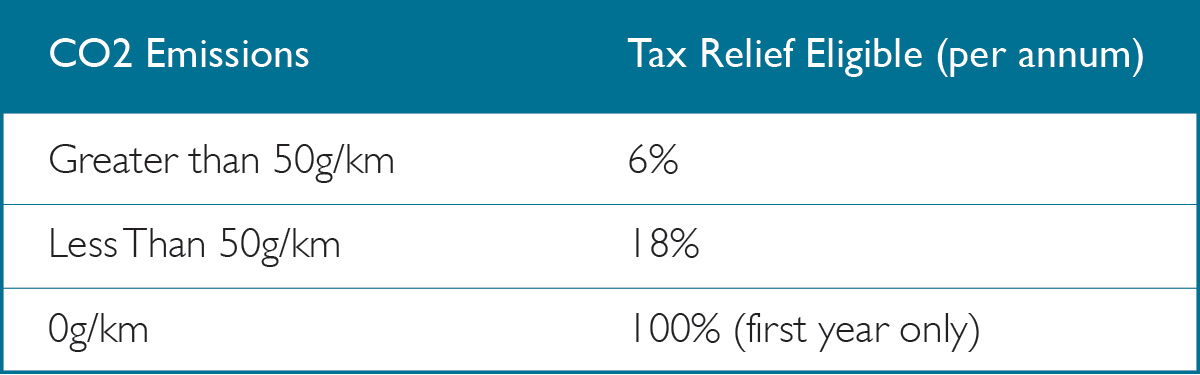
If the purchase has been financed with a loan, tax relief is also available on the loan interest paid.
Hire Purchase (HP)
Under an HP agreement, legal ownership of the vehicle passes to the buyer at the date the contract is signed. You will then simply pay for the asset over a period of time, normally on a monthly basis.
Monthly HP repayments will contain both an interest and a capital repayment element. The capital element is not an allowable deduction against business profits, whereas the interest element is.
You will also be able to claim capital allowances in the same way as for an outright purchase as above.
Lease
There are two types of lease; an operating lease and a finance lease.
An operating lease is where the business simply pays a rental payment to the legal owner of the asset. The monthly rental payments are an allowable expense but the amount that can be claimed will be restricted to 85% if the vehicle is a car with CO2 emissions exceeding 50g/km.
If a finance lease has been taken out, the business is required for tax purposes to treat the lease in the same way as if the asset had been acquired by way of a loan. The business will therefore depreciate the asset over its normal life, and will charge depreciation and interest payments against business profits. This is one of the only times a business will get a tax deduction for depreciation.
In either situation, the asset is being borrowed from someone else, so no capital allowances can be claimed.
If your business is VAT registered, you can also reclaim 50% of the VAT relating to the lease of company vehicles.

Pool Vehicles
Pool vehicles are a great choice if you have several employees needing to use a company vehicle for work, but where you don’t want to allow them to use the vehicles privately.
HMRC are very keen to ensure that employees don’t use pool vehicles as their regular vehicle in an attempt to avoid tax. You therefore have to meet, and prove, the following conditions:
- It can’t be available for private use by any employee
- It must be made available, and actually used by, more than one employee
- It must not be ordinarily used by one employee to the exclusion of others
- Any private use of the vehicle must be for the purpose of business (for example, if the car were to be taken home to allow an early start on a business trip the following morning)
- The car must not normally be kept overnight at any employee’s home, other than the circumstances described above

Is it a Car or a Van?
The tax differences between a car and a van can be significant, so it is important to make sure a vehicle has been treated correctly.
The confusion has mainly centred around double-cab pickup vehicles which sit somewhere between a car and a van. Previously these were capable of being classified as a van for tax on benefits in kind and VAT, providing they met certain criteria. This area has had some back and forth in recently with decisions and U-turns, however the October 2024 Budget did give some final clarification.
The issue arose because VAT and benefits in kind use different definitions for what counts as a van, and the less stringent criteria used to define a van for VAT were also being applied to benefits in kind. This allowed double cab pickup type vehicles to benefit from the lower van benefits. However, from 5 April 25, HMRC are taking a stricter approach in relation to vans for benefits in kind. The VAT treatment remains the same.
For VAT:
A car is a vehicle which, while being adapted solely or mainly for carrying passengers and with roofed accommodation to the rear of the driver, also has a payload of under one tonne.
Anything with a payload of over one tonne is classified as a van even with a double row of seats.
This treatment is unchanged.
For benefit-in-kind (BIK) purposes, cars and vans are defined by ITEPA 2003 s115.
A car is defined by what it is not i.e. it is not a “goods vehicle”.
A van, on the other hand, is a “goods vehicle”, with a design (laden) weight of 3.5 tonnes or less.
The statute then goes on to define a “goods vehicle” as “a vehicle of a construction primarily suited for the conveyance of goods or burden of any description”.
For benefits in kind vehicles have to consider a two-part test considering the construction of the vehicle and whether that construction is primarily suited for carrying goods or passengers. A vehicle has to be primarily suitable for transporting goods to be classified as a van. Something that is equally suitable for transporting goods or passengers will not meet the criteria. This applies even if it is capable of carrying a payload over one tonne.
It means that from 6 April 25 the majority of double cab pickups will not meet the criteria for being classed as a van and the car benefits in kind will apply.
Transitional arrangements will apply in relation to benefits in kind on existing vehicles, leases in progress and orders placed prior to 6 April 25, This will allow the previous treatment to be applied up to the earlier of disposal date, lease expiry or 5 April 2029.
The change also impacts capital allowances because new double cab pickups purchased after 5 April 25 that are classified as cars will have lower rates available (see section 6. Should I Buy or Lease my Company Vehicle?), unless they are electric. Whereas for a van purchase you can generally claim 100% of the value against profits in the year of purchase.